The Parthenon, 5th Century BC, and finally its own Museum at its feet, by Swiss architect Bernard Tschumi. Do an images search right now to appreciate it. Thank you, Greece. We have not seen it yet (parts of columns and other items were there on the grounds, but under shelters, so we have an idea where it is) but the descriptions put it among the great designs for museums, we think. See the article in the NYT 10/28/2007, article about p. 31 by Nicolai Ouroussoff: building was raised on columns to preserve an ancient village discovered below, "overscale concrete canopy" over the entrance, concrete and glass grid, corners of the top floor cantilever slightly, all creating an "instability" that serves the narrative as the goer goes through the exhibits. Yet, "calm and unobtrusive." Forms growing more precarious, says the article. "A montage of visual experience." The article directs us to slide show at nytimes.com/design.
Wish we had this for the old Iraq museum. We have little idea, and now it is too late, thanks to us.
Much of Greece's treasure of antiquities were taken to other countries in the last century, and even probably to now, with even half of the famous Elgin Marbles still at the British Museum in London - taken there by one Lord Elgin - still in London. Read about Lord Elgin at ://www.athensguide.com/elginmarbles/lordelgin.html; and the Elgin Marbles at ://www.athensguide.com/elginmarbles/index.html#menu. Mr. Ouroussoff went to London immediately after Athens, saw the Elgin Marbles there, and said they looked homesick.
Theft of heritage. See ://www.museum-security.org/artifacts-saz.htmWas Elgin the one who saved the marbles by taking them? See ://www.bbc.co.uk/history/ancient/greeks/parthenon_debate_01.shtml.
Iraq. See ://www.pbs.org/newshour/updates/middle_east/jan-june07/artifacts_04-30.html. The US not concerned or safeguarding another nation's heritage.
What is in our cultural narrative that so degrades the past. Even our own. Do we teach our real history. Read "Mayflower," by Nathaniel Philbrick, at ://www.nytimes.com/2006/06/04/books/review/04shorto.html?ex=1307073600&en=3ff4700633a5d05c&ei=5088&partner=rssnyt&emc=rss.
Human opportunism, here, in politics, there, and elsewhere. Mr.Ouroussoff writes that even he could see little reason at this late date to do any returning, but he changed his mind after entering the New Acropolis Museum.
A village was discovered during construction, and that is preserved because the structure is elevated above - excellent.
Wednesday, January 23, 2008


Tuesday, September 18, 2007
Parthenon and its Outlying Neighborhoods - Life Uncropped
 Parthenon, Athens, Greece
I. Most photos that show the Parthenon will focus on its antiquity and leave out its environment, its present context. What is the Acropolis, the rock on which the Parthenon, Temple of Athena, patron goddess of Athens rises.
Update 2014: Explore the meaning of the Parthenon's frieze. Read The Parthenon Enigma, Joan Breton Connelly, review by Caroline Alexander in the NYT at http://www.nytimes.com/2014/01/26/books/review/the-parthenon-enigma-by-joan-breton-connelly.html?_r=0/
- Do the figures depict a religious procession, where a dedicated robe is offered to the goddess. But there are inconsistencies. Is it instead a depiction of a sacrifice of a child, not merely a child handing over a robe. Or is it not a continuous story at all, but separate subjects.
And what is the shortened story of Athena that comes to us? What more is to learn, see Parthenon, Athena, Athene Partheneia
II. The Surround
Look further to the rooftops below. There are real neighborhoods surrounding. The markets. The Plaka. Who is there? Archeology can tell us that there was indeed crowding and disease in Athens then, as we have now, see http://www.archaeology.org/online/news/kerameikos. Enjoy the Parthenon in a fuller setting here: the warren of the market, the housing, rooftops, awnings against the sun, real people living nearby.
Should we have cropped out the neighborhoods, to focus on the Parthenon? Crop the picture, crop the narrative, exclude important evidence, reduce how people think, create and send a new agenda. All becomes marketing.
III. Ambiguity of the Frieze. The Elusive Past; the persistent sales job for agenda du jour
Are the ancient Greek battles like Serbia's battle of Kosovo Plain, 1389. Do interpretation and drive for an ideology create new facts where before they were not clear at all. Who really won at Kosovo Plain? Who did the epics say won, and why? Later interpretation and need for myth, filling in where the facts are not at all clear. See Europe Road Ways Themes, Kosovo I and Kosovo II.
It is the tellers of tales who dominate any time facts are concealed or cannot be accessed. Politics?
Thursday, August 30, 2007
Nafplio or Nafplion - Peloponnese, Venetians
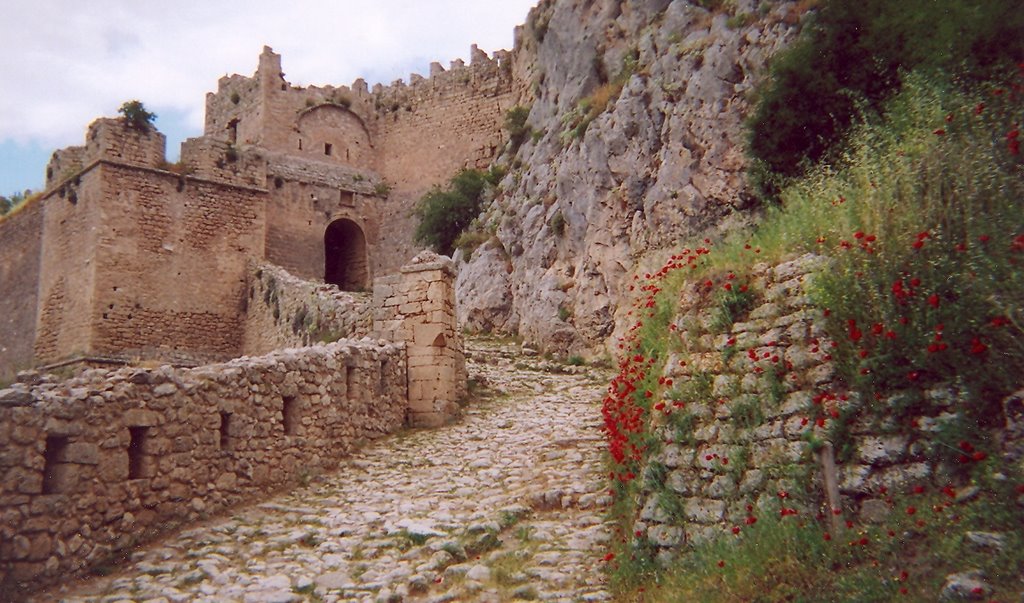
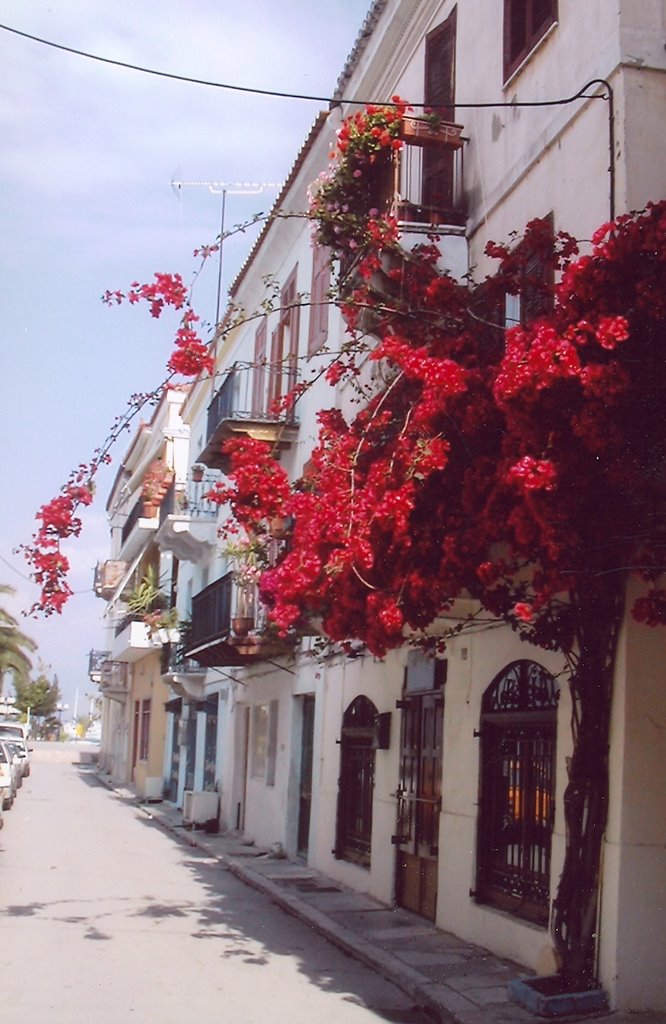 Nafplio, Peloponnese, Greece
Update August 2007 - with the fires in the news, but I think mostly inland.
Nafplion is on the Peloponnese Peninsula, coast, southeast of Athens and the mainland. This is a beautiful resort destination. Imagine great romance. Not difficult in this setting. It was occupied by the Venetians, look up the place names associated with the old Venetian empire at //romeartlover.tripod.com/Salmglos., then to the History of Venice, then down to Napili di Romania, Port of Morea on the Gulf of Argos (Argos was the ancient town there), and see that its current name is Nafplion.
Click on the links there for the port and the fortress --there is a 15th century fort at the top of the hill. See //romeartlover.tripod.com/Argo; and //romeartlover.tripod.com/Nauplia.
The modern town: elegant Greek-Venetian architecture. Splendid for a cruise stop. See www.greecetravel.com/nafplio/ For other history and photos, see www.delboy85.tripod.com/ppenese/id6.
On the way: artichoke fields. In bloom. Read the historian Herodotus on the ancient world 450BC. or so, for an idea of the vibrancy and movement among peoples. Artichokes at that time in Mauritania, says Strabo - huge. //www.fordham.edu/Halsall/ancient/anc-nafrica.
Wednesday, August 29, 2007
Meteora - clifftop monasteries
The geology of Meteora: It had been, in remote times, undersea, rivers then carving around prominences as water fell, land exposed. See http://www.meteora-greece.com/
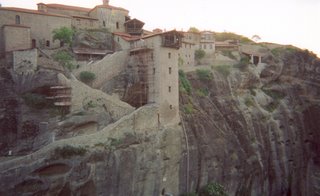 Meteora, Monastery, Greece
Monasteries were constructed on cliff-tops, many on free-standing geological formations like air islands. If At the center here, see see the ropes hanging down that suspended the baskets that were the only way up for people and goods in the old days. There also was a suspended rope between the monastery and the cliff on the other side, for a way over. See http://www.in2greece.com/english/places/historical/mainland/acropolis.
Geo-tourism: This site would be excellent. See book "Geotourism" by Ross Dowling at this site: http://www.elsevier.com/wps/find/bookdescription.cws_home/706060/description#description.
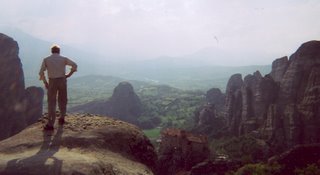 Meteora view, Monasteries, Greece
These monasteries were built around 1100 AD and thereafter, by hermits and monastics fleeing from the invading Ottomans, or for their own reasons - preferring isolation. See history of Meteora, http://www.greeka.com/thessaly/meteora/meteora-history.htm
There is an entire area of these stacks with or without structures on top. See www.orthodox-monasteries.com/greece/index5. See also www.in2greece.com/english/places/historical/mainland/meteora.
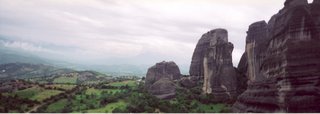 Meteora, Creece. Conglomerate rock formations, and medieval monasteries
One story of how these were built:
 Rock formations, monastery at summit, Meteora, Greece
These are World Heritage Sites. The area is on the list for many tour groups. See www.great-adventures.com/destinations/greece/meteora.
Wardrobe for Orthodox areas:
This is an orthodox area. Ladies, wear a skirt (I had a denim one, mid-calf, for easier climbing). Some women had a light shawl wrap, square-ish, that could be wrapped like a sarong to cover trousers.
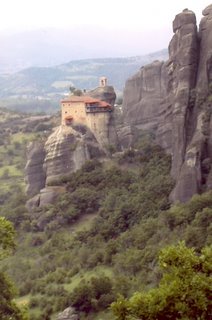 Clifftop monastery, Meteora, Greece
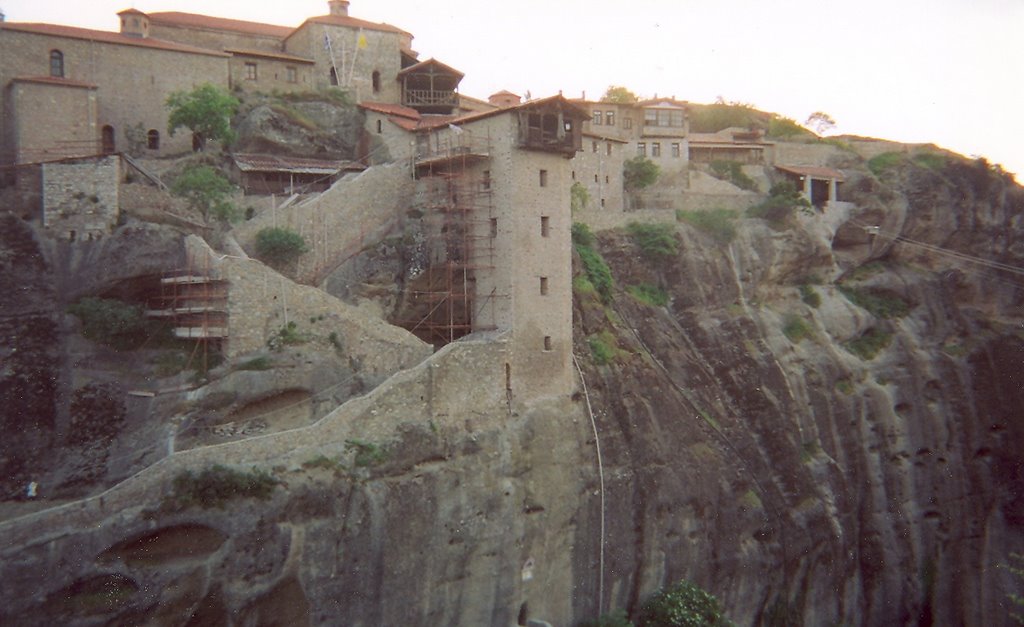 Meteora, Monastery, Greece
Monasteries were constructed on cliff-tops, many on free-standing geological formations like air islands. If At the center here, see see the ropes hanging down that suspended the baskets that were the only way up for people and goods in the old days. There also was a suspended rope between the monastery and the cliff on the other side, for a way over. See http://www.in2greece.com/english/places/historical/mainland/acropolis.
Geo-tourism: This site would be excellent. See book "Geotourism" by Ross Dowling at this site: http://www.elsevier.com/wps/find/bookdescription.cws_home/706060/description#description.
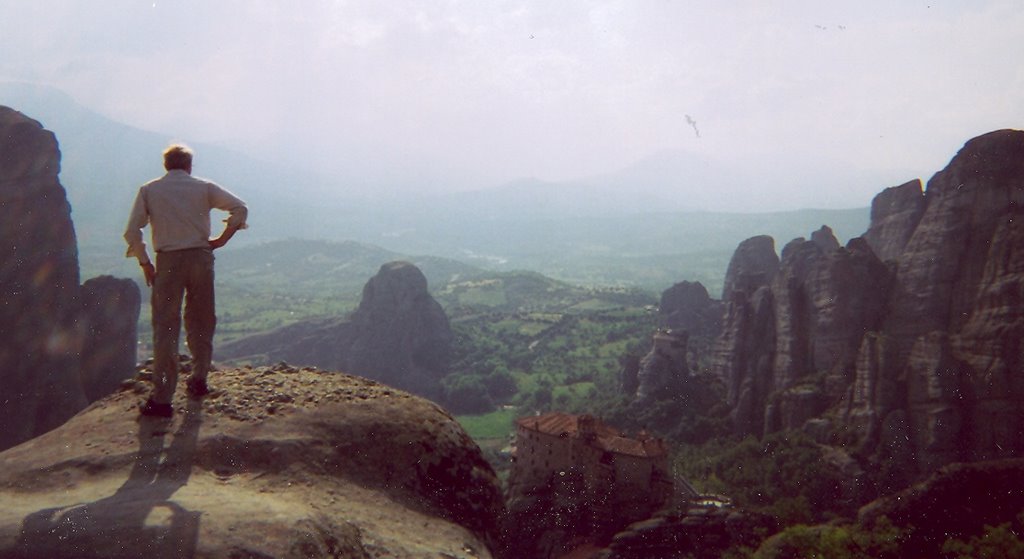 Meteora view, Monasteries, Greece
These monasteries were built around 1100 AD and thereafter, by hermits and monastics fleeing from the invading Ottomans, or for their own reasons - preferring isolation. See history of Meteora, http://www.greeka.com/thessaly/meteora/meteora-history.htm
There is an entire area of these stacks with or without structures on top. See www.orthodox-monasteries.com/greece/index5. See also www.in2greece.com/english/places/historical/mainland/meteora.
 Meteora, Creece. Conglomerate rock formations, and medieval monasteries
 One story of how these were built:
- A hermit made his way to the top of one summit, and wondered how to proceed with shelter. An eagle came by and dropped him a feather. Then, it dropped a piece of twig, and then enough materials to fashion a rope.
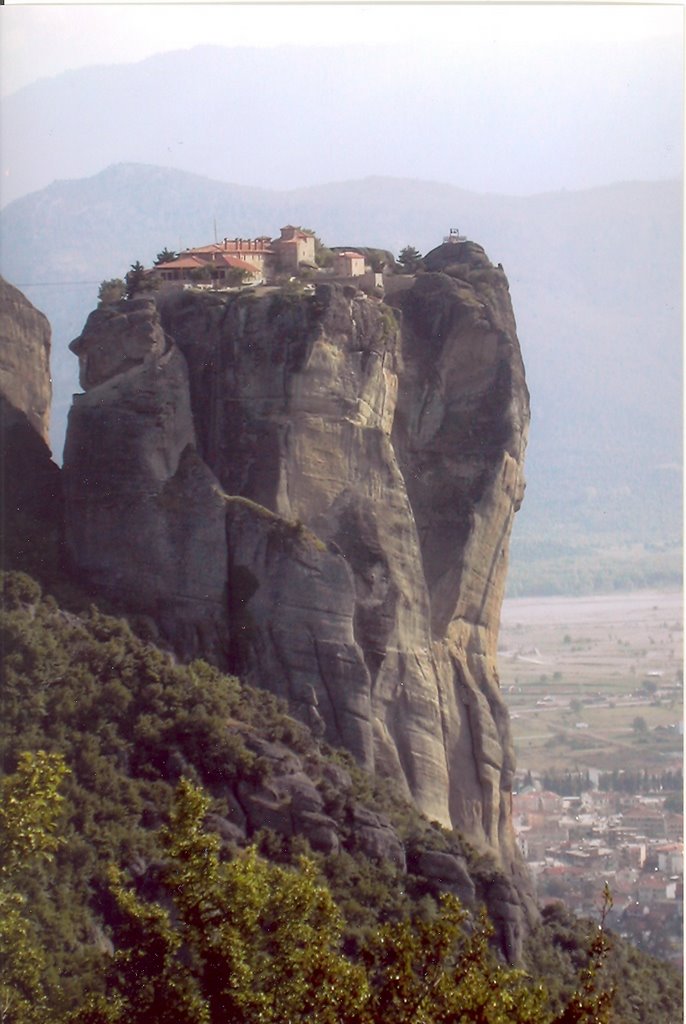 Rock formations, monastery at summit, Meteora, Greece
These are World Heritage Sites. The area is on the list for many tour groups. See www.great-adventures.com/destinations/greece/meteora.
Wardrobe for Orthodox areas:
This is an orthodox area. Ladies, wear a skirt (I had a denim one, mid-calf, for easier climbing). Some women had a light shawl wrap, square-ish, that could be wrapped like a sarong to cover trousers.
- . If you are dressed inappropriately, including either long pants or shorts, the monastery will loan you a shawl from a large stack in the corner. Ladies in shorts or pants not allowed.
- Cover your shoulders. Carry around your own silky covering or buy one of the sarong squares. This is more convenient than raincoats, and serves for picnics and tidier car snacking.
 Clifftop monastery, Meteora, Greece
Tuesday, August 28, 2007
Fires on the Peloponnese.
 Olympus, view. Greece
Where are the gods when we need them?
Travel makes news personal. In August 2007, there were vast fires on the Peloponnese peninsula. For an idea of the scope, see the New York Times slide show today at //www.nytimes.com/slideshow/2007/08/28/world/20070828GREECE_index.html?th&emc.
If you are inclined to contribute, idea: Find a trusted local conduit and learn something of the people in your area from there. Visit Greek Orthodox churches for leads, or local schools that may have Greek exchange students, or find a trusted American project and follow through to check it out - example, try The American Farm School in Thessaloniki, Greece. Go to www.afs.edu.gr/. An advantage here is the English-speaking.
There is never assurance that all you contribute will get to the place or people needed. Leave it to the gods. Letting things go is good for your health.
Monday, June 18, 2007
Ioannina and Metsovo area - Orthodox, Vlach and Turkish roots, and hilltop village area
 Ionnanina, monastery, Greece
This area is north and west, from the Athens area, toward Albania. To the left here is an Orthodox monastery: one of many.
There are numerous hilltop towns.
 Metsovo, village, Greece
Metsovo is a large town, with a substantial Vlach and Turkish influence.
Vlachs originated as a shepherding, nomadic culture. See www.vlachophiles.net/liddell. We found Vlachs in Romania, see Romania Road Ways;.
The picture here is a small mountain town heading from Metsovo to Ioannina. Roadsign: See a fine photo album at www.galenfrysinger.com/metsovo_greece. The area is highly traditional, old Turkish influence also there.
Then, at Ioannina, is the administrative capital of the region, there are palace-castle ruins, and Turkish homes now open as museums. There is a lovely mosque. See www.arafura.net.au/greeksnt/ioannina; and www.metsovo.gr/.
Sunday, January 07, 2007
Driving tips, foreign alphabet
The Greek alphabet is difficult for most of us. So is Cyrillic (parts of Bosnia, in particular. See Bosnia Road Ways). Not all signs will have English on them, or an anglicized alphabet, especially in rural areas. This is their country. Expect and respect their language.
1. Write down the basic signs as you see them. Or get them out of your guidebook in advance. Start immediately. Keep a pad close by the driver's seat. Don't rely on guides - the print is little and you will not have time. Do know the international driving signs, but in addition:
EXIT
DETOUR
BY-PASS
CENTER CITY
All that. If you write them on the backs of your hands, wash carefully.
2. Use a tourist attraction as your anchor. If you want to get somewhere in Athens with a street address, go to the map and find the nearest big tourist attraction to it. Say, the Acropolis. Then, when you get lost, as you will, do not try to ask directions to the street address too soon. Really. There are too many little streets and turns and one-ways. You may even be told that you can't get there from here this time of day.
Find or ask for a motorway heading to the attraction near your destination - like the Acropolis. If you are in a smaller town, just ask for the destination attraction. Cruise around pleasantly while you look for someone to ask about the Acropolis, or find the motorway with the tourist attraction signs - the large green overheads like we have here. Once on a motorway, see if the Acropolis is going your way. If not, get off and on again until you are headed for the Acropolis. Get off there, and you will be closer to where you really want to go.
We did not do this at first, and were very late for dinner.
1. Write down the basic signs as you see them. Or get them out of your guidebook in advance. Start immediately. Keep a pad close by the driver's seat. Don't rely on guides - the print is little and you will not have time. Do know the international driving signs, but in addition:
EXIT
DETOUR
BY-PASS
CENTER CITY
All that. If you write them on the backs of your hands, wash carefully.
2. Use a tourist attraction as your anchor. If you want to get somewhere in Athens with a street address, go to the map and find the nearest big tourist attraction to it. Say, the Acropolis. Then, when you get lost, as you will, do not try to ask directions to the street address too soon. Really. There are too many little streets and turns and one-ways. You may even be told that you can't get there from here this time of day.
Find or ask for a motorway heading to the attraction near your destination - like the Acropolis. If you are in a smaller town, just ask for the destination attraction. Cruise around pleasantly while you look for someone to ask about the Acropolis, or find the motorway with the tourist attraction signs - the large green overheads like we have here. Once on a motorway, see if the Acropolis is going your way. If not, get off and on again until you are headed for the Acropolis. Get off there, and you will be closer to where you really want to go.
We did not do this at first, and were very late for dinner.
Tuesday, January 02, 2007
Athens, Unknown Soldier, Evezone Guard, and Acropolis
 Acropolis, Greece
There is Athens at sunset, with the Acropolis, from our friends' roof garden.
 Evezone Guard, Syntagma Square, Athens, Greece
And the Evezone Guard at Syntagma (Constitution) Square, at the tomb of the unknown soldier. There is a stylized march step and the uniforms are based on an 1821 war of independence.
Full details of the Guard, and the 400 pleats representing the 400 years of Ottoman rule, says the site, is at www.wright-photo.com/evzone3. Click back a few pages for more on the Guards there.
The Acropolis is a World Heritage Site. See the Ministry of Culture site at www.culture.gr/2/21/211/21101a/e211aa01. There are photos, and a historical account.
 Parthenon, Acropolis, Greece
The Parthenon at the Acropolis is being restored in an ongoing process. That same site is good also for a brief look at some of the Acropolis - www.wright-photo.com/acropolis1. This continues for two more pages at the site. The full websites photo gallery for Athens, including the old Plaka market/residence and historic structures at the base of the Acropolis, is at www.wright-photo.com/athens0.
See also www.in2greece.com/english/places/historical/mainland/acropolis.
Wednesday, December 20, 2006
Links, posts, archives
No underlined links to third-party sites here, just written addresses. Please take the time to follow up on the details, even though we have to slow up. Why slow us up like this? See www.bitlaw.com for overviews on internet law and copyright. These things are more complex than we ever dreamed, and nothing seems clear. In transition.
Post dates show the itinerary chronology - from arrival, to departure. So, do read the Archives - they show the continuing trip, not necessarily earlier posts. A new or revised post may appear at the beginning, to draw attention to it, but the plan is to incorporate it later elsewhere, if it fits better there.
Technorati Profile
Post dates show the itinerary chronology - from arrival, to departure. So, do read the Archives - they show the continuing trip, not necessarily earlier posts. A new or revised post may appear at the beginning, to draw attention to it, but the plan is to incorporate it later elsewhere, if it fits better there.
Technorati Profile
Tuesday, December 05, 2006
Thessaloniki area: American Farm School
Everyone involved with the campus and programs at this secondary school (boarding school) should be very proud. Many American teachers and their families. The school teaches a broad curriculum to boys and girls in the context of also teaching modern agricultural techniques and issues. We went to a graduation and the top student is given a calf that is proudly led right on the stage.
They also have an exchange program for summer high school students from the US, who then live with Greek families (farm? I believe so)and a friend's daughter loved it. Other friends (really like family) are committed to its growth as well. With all the bad press Americans get from other activities abroad, this one deserves huge kudos. There is physical sense of relief to come across things like this, as an American. And to see the deep commitment of the Greek adminstration and trustees. See www.afs.edu.gr/en/index. Also see www.americanfarmschool.org/.
I am not involved with any of this other than cheering on the people we know who have been instrumental in its success - just very, very, impressed.
At that graduation, we noticed that so many of the parents were short-statured, while the children were much taller. We were told that the improvement in diet has made a big difference in the height of the young people, and were reminded that many of the parents and their parents lived through the food and health deprivations of wars. That makes sense.
They also have an exchange program for summer high school students from the US, who then live with Greek families (farm? I believe so)and a friend's daughter loved it. Other friends (really like family) are committed to its growth as well. With all the bad press Americans get from other activities abroad, this one deserves huge kudos. There is physical sense of relief to come across things like this, as an American. And to see the deep commitment of the Greek adminstration and trustees. See www.afs.edu.gr/en/index. Also see www.americanfarmschool.org/.
I am not involved with any of this other than cheering on the people we know who have been instrumental in its success - just very, very, impressed.
At that graduation, we noticed that so many of the parents were short-statured, while the children were much taller. We were told that the improvement in diet has made a big difference in the height of the young people, and were reminded that many of the parents and their parents lived through the food and health deprivations of wars. That makes sense.
Subscribe to:
Posts (Atom)